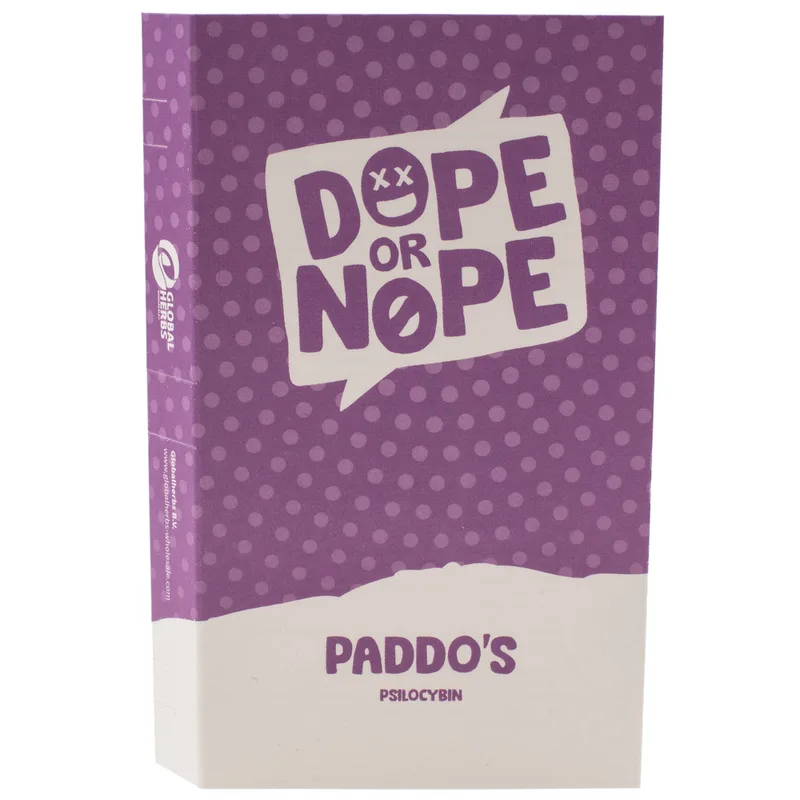
The Dope or Nope magic mushroom test shows whether a sample of mushroom or truffle probably contains psilocybin. The Dutch pack calls it Paddo's. A tiny piece goes into the ampoule; the colour tells you whether psilocybin is probably there.
What the mushroom test checks
Psilocybin is the active substance in magic mushrooms and magic truffles. The test answers whether psilocybin is probably present in your sample. It does not tell you how strong the mushrooms are, and strength is hard to predict: FRANK notes that it varies with freshness, the season and where the mushrooms grow (FRANK, magic mushrooms).
Mushrooms picked in the wild bring another risk: FRANK warns that many poisonous mushrooms look very similar to magic mushrooms. A colour test does not tell you whether a mushroom is poisonous. It only looks for psilocybin. Never rely on it to identify a wild mushroom.
Use only a very small piece; the leaflet has the details. No reaction, or a colour that is not on the chart, means no psilocybin was found in that piece.
Colour chart
Reading the colour
The expected colour and reaction time for this test are printed on the colour chart in the pack. Always compare your result with that chart.
| What you see | What it means |
|---|---|
| Expected colour for this test | See the colour chart in the pack |
| A colour that matches the chart | The sample probably contains (some of) the substance on the chart. It says nothing about the amount or about other substances. |
| No reaction, or a colour that is not on the chart | You are not dealing with the substance on the chart. What it is instead stays unknown: discard the sample. |
What a result tells you, and what it does not
A Dope or Nope test is a presence test. When the liquid turns a colour that is on the chart, the sample probably contains (some of) the substance or substance family named there. That is all the colour says.
- It does not measure purity or dose. The test does not show how much of the active substance is in your sample.
- It does not see everything. Another substance that the test does not recognise can sit in the same sample.
- It does not make anything safe. A matching colour is no promise of a safe experience. No drug use is without risk.
- No reaction, or a colour that is not on the chart, means you are not dealing with the substance on the chart. You then cannot say what the sample is. It might be harmless or extremely dangerous: throw it away.
The page on reading results explains false positives, false negatives and cutting agents in more detail.
Manual
How to use Dope or Nope
Use only a tiny bit of your sample, about the size of a pinhead.
- Take the ampoule
- Break the ampoule
- Add your sample
- Twist the top
- Put the top back on the ampoule
- Compare the colour
Before you start
Each pack holds one single-use test. Work on a clean, dry and stable surface in good light, and keep the leaflet with the colour chart next to you. Use only a tiny bit of your sample, about the size of a pinhead: that is what the pack asks for, and more material does not give a better reading.
The ampoule contains a strong acid. Keep it upright and point it away from your face when you break it. Use a new test for every sample: a pill from another batch or powder from another bag counts as a different sample.
Safety and storage
Using this test is at your own risk. It gives an indication of the identity of the active substance(s) and therefore cannot offer 100% certainty; no rights or guarantees can be derived from it. The liquid contains a strong acid: keep the test out of reach of children and avoid contact with eyes and skin, as it can cause irritation. If the liquid touches your skin or eyes, rinse with plenty of water.
Store the pack cool and dark, below 35 °C (95 °F), in its original packaging. The test is meant for adults (18+).
Next steps
Updated: